
What an Amazon Connect AI voice agent actually costs
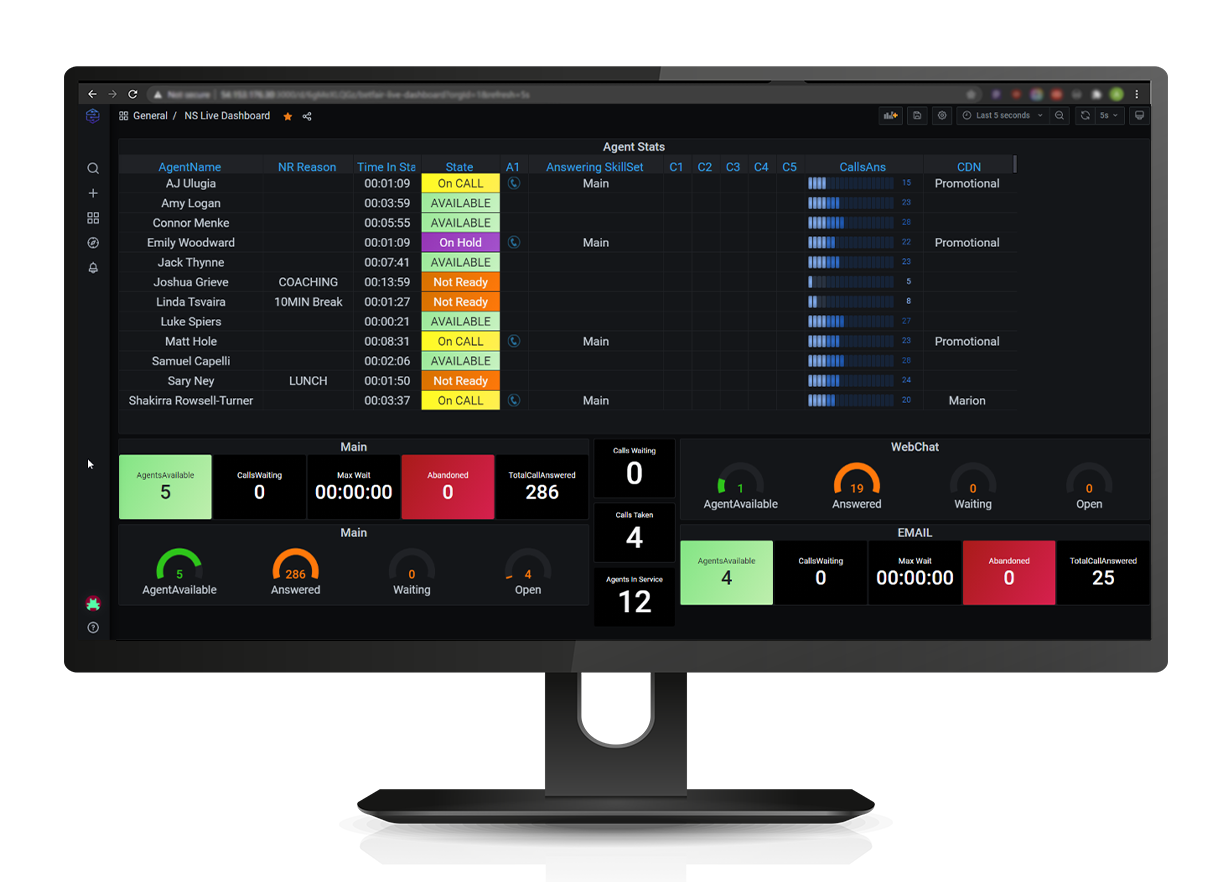
Four cost lines, three of them usage-based, and only one is a licence. Most AI voice pricing is quoted as a single per-minute number, which is convenient and misleading, and the four sit under every AI agent on Amazon Connect whoever you buy it from. Here's the whole model, a worked example you can put your own numbers into, and the places the curve bends.
Costing the contact centre underneath rather than the AI agent on top? What Amazon Connect actually costs sets out the three stacks on an Amazon Connect bill and the two dimensions still billed per agent per month.
The four cost lines
Whatever you buy and whoever you buy it from, an AI-handled call on Amazon Connect generates charges in four places.
1. Amazon Connect service and telephony. AWS bills Connect voice per minute for the service, plus telephony per minute for the number and the carriage — and telephony rates vary a lot by country, by inbound versus outbound, and between a direct-dial number and a toll-free one. This line is unchanged by putting an AI on the call. An AI-handled call costs exactly what a human-handled call of the same length costs on this line. The saving is agent time, not telephony. Price yours from the AWS pricing page for your region; don't accept a vendor's estimate for a rate AWS publishes.
2. Speech. Speech-to-text and text-to-speech, billed per minute or per character by whichever provider you use. This is where residency choices show up as money as well as compliance, because the onshore-capable providers and the premium-voice providers are usually not the same vendor.
3. The language model. Billed per token — input and output priced separately — or rolled into a vendor's per-minute figure. Voice conversations are short in token terms compared with document work, but the system prompt, the tool definitions and the running conversation history are re-sent on every turn, which is what makes long calls disproportionately expensive.
4. The agent licence. The product itself: a subscription, a bundle, or your own engineering team's time if you built it. Approach matters here — we compare the four build-versus-buy routes in how to add an AI voice agent to Amazon Connect.
Line 1 belongs to AWS. Lines 2 and 3 belong to AWS or a speech and model vendor. Line 4 is the only one a Marketplace listing price refers to. A quote that shows you one number without saying which lines it covers is not a quote, it's a hope.
Worked example: 1,000 calls a month
Use your own rates; the structure is the point. Assume 1,000 AI-handled calls a month averaging four minutes each — 4,000 voice minutes.
- Connect + telephony: 4,000 × (your Connect voice service rate + your per-minute telephony rate for that number type and country). Do this one first, because for short calls in expensive telephony markets it can be the largest line, which surprises people.
- Speech: 4,000 × your combined recognition and synthesis rate. Note that synthesis is billed on what the agent says, not on call duration, so a concise agent is a cheaper agent.
- Model: roughly (turns per call × tokens per turn) × 1,000 calls, at your model's input and output rates. Estimate turns per call from your existing transcripts rather than guessing — you already have the data in Contact Lens.
- Licence: for ProUCX's Live AI Agent, an AWS Marketplace bundle at US$300, US$1,000 or US$3,000. Check the listing for current bundle sizes and terms.
Two habits make this exercise honest. First, work in minutes, not calls — average handle time drives three of the four lines, and a 40-second containment and a nine-minute conversation are not the same product. Second, model the abandoned and mis-routed calls too. A caller who says three words and asks for a person still consumes telephony and speech.
Where the cost curve bends
Four inflection points do more to your bill than any rate negotiation.
Average handle time. Three of the four lines are per-minute or per-turn. A well-scoped agent that resolves a call in ninety seconds is not marginally cheaper than one that meanders for five minutes — it is roughly three times cheaper, on every line except the licence. The cheapest optimisation available is a tighter prompt and a shorter greeting.
Concurrency, not volume. Speech and model providers sell concurrency tiers. Ten thousand calls spread evenly across a month is a small problem; the same ten thousand arriving between 9am and 11am on the first Monday after a billing run is a different tier. Size against your peak concurrent calls, not your monthly total, or your first busy day will be an outage rather than an invoice.
Containment rate. A call the AI resolves costs you four lines once. A call the AI works for two minutes and then transfers costs you four lines plus the full human handling cost. Below a certain containment rate an AI agent adds cost rather than removing it — which is why the warm handoff matters commercially and not just for customer experience. When the summary, intent and transcript land in the agent's CRM screen-pop, the human leg is shorter, so a transferred call is not a total loss.
Residency. Requiring an onshore Australian speech path narrows your provider list, and a narrower list is a weaker negotiating position. That is a real cost of compliance and it should appear in the business case rather than as a surprise in month two.
Marketplace metered versus direct
The same product bought two ways lands in different budgets, and for larger organisations that matters more than the sticker price.
Through AWS Marketplace, the subscription appears on the AWS bill you already receive and reconcile. There is no new vendor to onboard, no new payment instrument, and for many organisations eligible Marketplace spend can count toward an existing AWS commitment — worth confirming with your account team. Procurement time is often the real saving.
Direct gives you a normal commercial conversation: negotiated terms, invoicing in your own currency arrangements, and bundling across products. If you are also buying CRM connectors or wallboards, a combined quote is usually the better route — the pricing page lists the direct plans.
One planning note: ProUCX's AI products are priced in USD, so Australian buyers should build an FX assumption into a twelve-month business case rather than converting at today's rate and forgetting about it.
How it compares to adding a person
The comparison people reach for is "AI agent versus a new hire", and it's the right instinct done wrong. Don't compare against a salary; compare against your own fully-loaded cost per handled contact, which you can calculate from figures you already have: total cost of the team (salary, on-costs, supervision, recruitment, training, attrition, seat and licence) divided by contacts handled. Most contact centres have never worked this out and are startled by it.
Then set the AI's cost per handled contact — all four lines, divided by contacts it actually contained — against that number, and apply three adjustments most business cases miss:
- Only count contained calls as replaced. Transferred calls are assisted, not replaced. Value them at the handle-time reduction the warm handoff produces, which you should measure in a pilot rather than assume.
- Count the capacity you don't have to buy. The strongest case for AI in most Australian contact centres is not head-for-head replacement, it is absorbing peaks — a product recall, a billing run, a weather event — without hiring for a peak you staff twice a year. An AI agent can be moved in and out of queues on demand.
- Count the hours you can't currently staff. Answering at 11pm has a cost of zero people if nobody is rostered, and a very high cost per contact if someone is.
A fair business case usually lands on "this changes what we can offer" rather than "this removes N people", and it survives scrutiny far better as a result.
What to ask a vendor
- Which of the four lines does your price cover, and which will I be billed for separately?
- Is the price per minute, per call, per session or per concurrent line — and what happens at the tier boundary?
- What concurrency does my tier actually allow?
- What do I pay for a call the AI can't contain?
- What changes if I require an onshore Australian speech path?
- Can I buy it through AWS Marketplace on my existing bill?
Any vendor who can't answer all six in a single email is quoting you a hope too.
The short version
Four lines: Connect and telephony, speech, model, licence. Three are per-minute, which makes average handle time the dominant variable and containment rate the one that decides whether the whole thing is worth doing. Size on peak concurrency, not monthly volume. And if you want to see how a call actually behaves before modelling it, the demo console at dev.ai.liveucx.com runs one end to end.
Common questions
How much does an AI voice agent cost per year?
There is no single annual figure, because only one of the four cost lines is a licence. Take your monthly voice minutes, price the Amazon Connect service and telephony against AWS’s published rates for your region, add speech and model usage on top, then add the licence — for ProUCX’s Live AI Agent, an AWS Marketplace bundle at US$300, US$1,000 or US$3,000, with current bundle sizes and terms on the listing. Multiply by twelve only after the per-minute lines are real numbers rather than estimates.
What is the total cost of ownership for an AI voice agent?
Four lines, three of them usage-based. Amazon Connect service and telephony, billed by AWS per minute; speech recognition and synthesis; the language model, billed per token; and the agent licence. A quote that gives you one number without saying which of the four it covers is not a quote.
Is AI voice agent pricing per minute or a subscription?
Both, and that is the confusion. The licence is usually a subscription or a bundle, but the three usage lines underneath it are per minute or per token and they do not stop when the subscription is paid. A vendor quoting a single per-minute number has folded some of those lines into their own rate; ask which ones.
What does an AI voice agent cost in Australia?
The licence does not change, but two of the usage lines do. Australian telephony rates differ from US ones and differ again between direct-dial and toll-free numbers, so price line one from AWS’s own pricing page for your Australian region. Speech can also cost differently if onshore processing is a requirement, because the providers with an Australian presence and the providers with the most natural voices are not always the same vendor.
Is an AI voice agent cheaper than hiring a person?
On the telephony line it makes no difference at all — an AI-handled call costs exactly what a human-handled call of the same length costs. The saving is agent time, not carriage. Whether that saving exceeds the speech, model and licence lines depends almost entirely on how long your calls run and what share the agent actually resolves without a person.
What makes one AI voice agent more expensive than another?
Mostly average handle time, not the rate card. Three of the four lines are per-minute or per-turn, so an agent that resolves a call in ninety seconds is roughly three times cheaper than one that meanders for five minutes on every line except the licence. Concurrency tier is the second factor: speech and model providers price on peak simultaneous calls, so the same monthly volume costs differently if it arrives in bursts.
Does Amazon Connect charge more per minute for an AI-handled call?
No. AWS bills the Amazon Connect service and the telephony per minute at the same rate whether a person or an AI agent is on the call. Putting an AI on the call does not change line one; it changes who spends the time.
What should I ask a vendor before signing?
Which of the four lines their price covers, and which you will be billed for separately. Then ask for the average handle time and containment rate behind any saving they quote, because those two numbers determine whether the arithmetic holds for your contact centre rather than theirs.
Price an AI agent against your own contact centre
See what Live AI Agent does, or subscribe on the AWS account you already have.
Four practical routes — a Lex bot in the contact flow, Bedrock with a custom Lambda, an external agent bridged in, or a packaged product from AWS Marketplace — and how to choose between them.
Lex is cheap, native and predictable until the intent list stops describing your callers. Where the design breaks, what a generative agent changes, and why containment beats deflection.
Amazon Connect speaks with Amazon Polly out of the box. What changes when an ElevenLabs voice agent answers the call instead, what the caller experiences, and how the warm handoff to a human works.