
Amazon Polly vs ElevenLabs: which voice should answer your Amazon Connect calls?
Polly for the menus, ElevenLabs for the conversation. It is the comparison every contact centre reaches once the greeting starts to grate. One is the text to speech engine already wired into the platform. The other is a speech synthesis company whose output people routinely mistake for human speech. They are not the same category of product, and choosing on voice quality alone is how these projects go sideways. Here's the comparison an Australian buyer actually needs.
This page compares the two voice engines. If you want the product, see the ElevenLabs voice agent for Amazon Connect.
What Amazon Connect speaks with today
Every spoken word in a stock contact flow comes from Amazon Polly. Drop a Play prompt block in, type text instead of uploading a WAV file, and Connect sends that text to Polly and plays the result down the line. You pick the language and the voice, shape delivery with SSML, and switch voices mid-flow with a Set voice block.
Polly is no longer the only voice the platform can use: the Set voice block now also offers third-party voice providers, ElevenLabs among them, with the API key held in AWS Secrets Manager. What has not changed is the nature of the thing. Text-to-speech, from Polly or anyone else, reads what it is handed and is not listening. Anything conversational still needs Amazon Lex in front of it, or something else entirely.
Amazon Polly: neural voices, standard voices and native AWS integration
Polly ships two long-standing tiers plus newer engines. Standard voices are the original concatenative models — serviceable, cheap, unmistakably synthetic. Neural voices are the ones you should be using in 2026, and AWS has since added further engines aimed at longer-form and more expressive delivery.
The commercial model is per-character: you are billed for the text you synthesise, at different rates by engine, with no seat licence and no minimum. Check the current AWS pricing page for the rates that apply to your region rather than trusting any number in a blog post, including ours.
Voice quality and voice naturalness
Polly's neural voices are good. They are not indistinguishable from a person, and on a 20-second prompt nobody cares. Voice naturalness becomes the deciding factor only when the caller is expected to hold a real conversation, because that is when the small tells — flat emphasis, wrong pause, a phone number read as one long string — start to signal "machine" and change how the caller behaves.
Where Polly wins decisively is control. SSML lets you spell an order reference digit by digit, insert a breath before a legal disclaimer, or force the pronunciation of a suburb name. That is deterministic. Nothing generative gives you that.
Languages and language coverage
Polly's language coverage is broad — dozens of languages and regional variants, and the catalogue of voices and languages includes Australian English on the neural tier, so an AU contact centre does not have to sound American. Language support extends to the SSML behaviour and lexicons around each voice, which matters more than the raw count.
The limitation is that you are choosing from a public catalogue that every other Connect customer is also choosing from. Your brand sounds like the platform.
Latency and where the audio is generated
This is the argument that wins most enterprise deals and gets the least attention. Polly runs in AWS regions including Sydney, so the audio is generated in the same region as your Amazon Connect instance. No internet hop, no cross-border round trip, and the generated speech can be cached. On telephony, where a 300 ms gap reads as hesitation, that is a real advantage rather than a spec-sheet one.
It is also the same account, the same IAM, the same CloudTrail and the same data-residency story you already signed off. That AWS integration is not glamorous and it is frequently the reason Polly stays.
ElevenLabs: lifelike voices and an expressive multilingual model
ElevenLabs is a speech technology company, not a cloud platform, and it optimises for the thing Polly treats as secondary: sounding human. Its lifelike voices carry intonation, hesitation and emphasis that survive the 8 kHz squeeze of a phone line, and its expressive voices are the reason people stay on the call instead of mashing zero.
The catalogue is only part of it. The differentiators are voice generation from your own recordings, a multilingual model that keeps one identity across languages, and an API built for real-time use.
Voice cloning: instant voice cloning and professional voice cloning
This is the capability Polly has no equivalent to. Instant voice cloning builds a usable voice from a short sample in minutes — good enough for prototypes, internal prompts and proving the concept to a steering committee.
Professional voice cloning is the production path: a longer, properly recorded dataset and a fine-tuned model, producing a voice close enough to the source that a listener will not pick it. If your brand already has a voice artist on retainer, this is how that person scales to every prompt, every language and every hour of the day.
Two obligations come with it. Get written, specific consent from the voice talent — Australian buyers get this wrong more often than they admit. And decide up front whether callers are told they're speaking to an AI, because the better the clone, the more that question stops being cosmetic.
Multilingual v2 and multilingual voices
ElevenLabs' Multilingual v2 model is the one most contact centres end up on. The point of it is not the count of languages but that a single cloned voice speaks all of them: multilingual voices with one consistent identity, rather than a different stranger per market. For an Australian organisation serving a multilingual customer base, that is a genuinely different product from picking a second voice out of a catalogue.
Polly's answer to multiple languages is a different voice per language. It works. It just doesn't sound like one brand.
Streaming, the TTS API and latency
The ElevenLabs TTS API supports streaming — audio starts returning before the full sentence has been generated — and the vendor publishes lower-latency model variants specifically for conversational use. Without streaming, a generative voice on a phone call is unusable; with it, the exchange holds together.
The honest caveat for this market: ElevenLabs has no Australian point of presence. Singapore is the closest, so every request leaves the country and comes back. Add that round trip to generation time and compare it against Polly generating in Sydney. For a lot of buyers the difference is acceptable and the voice is worth it. For agencies with a contractual residency obligation, it ends the conversation — and it should be settled before anyone books a demo, not after.
The other TTS providers: Google TTS, WaveNet and Microsoft
Polly and ElevenLabs are not the only two providers, and a serious shortlist names the other hyperscalers even if it discards them.
Google Cloud text to speech and WaveNet
Google Cloud Text-to-Speech is the closest structural analogue to Polly: broad language coverage, per-character billing, and a quality ladder from basic voices through WaveNet to later neural tiers. Google TTS is a fine engine. On Amazon Connect it is also an outbound API call from your contact flow to another cloud, which reintroduces exactly the network hop and the second vendor agreement that Polly removes. Choose it because you are already a Google Cloud shop, not because of the voices.
Microsoft and the enterprise speech technology stack
Microsoft's Azure AI Speech is the enterprise-procurement option, with neural voices, a custom neural voice programme and an Australian region. If your organisation is a Microsoft shop with a Dynamics 365 front end — the same buyers who run our Amazon Connect CTI for Dynamics 365 — it can be the path of least resistance through your own approvals process. Same trade-off as Google: better paperwork, extra hop.
ElevenLabs vs Amazon, on the jobs each is built for
The comparison gets clearer when you stop comparing engines and start comparing jobs.
- Prompts, menus and disclaimers. Short, repeated, must be pronounced identically every time. Polly, easily. Generative voices are an expensive way to say "your call is important to us".
- Audiobooks and expressive voiceovers. Long-form narration where performance is the product. ElevenLabs was built for this, and it shows.
- Conversational customer service. The caller talks, the system replies, the exchange has to feel like a conversation. This is where lifelike voices stop being decoration and start changing containment.
Most contact centres want both, and there is nothing incoherent about that: Polly on the deterministic prompts, a generative voice on the conversational leg. The Lex versus conversational agent comparison makes the same argument about the reasoning layer.
Picking a TTS provider for a consistent brand voice
If a consistent brand voice is a real requirement rather than a slide, the shortlist collapses fast. A catalogue voice can only ever be consistent with itself; a cloned voice is consistent with your advertising, your on-hold message and your video content. That is the case for ElevenLabs, or for a custom voice from one of the hyperscalers if the residency answer has to be onshore.
If it isn't a real requirement — and for a lot of organisations it genuinely isn't — Polly's Australian neural voice is one contact-flow block away and costs you nothing to trial.
Alternatives, and when to stop comparing engines
The alternatives worth naming are the ones that change the shape of the problem rather than the vendor: keep Polly and spend the budget on better flow design; record a human voice artist for your top twenty prompts and let Polly handle the tail; or accept that what you actually want isn't a nicer voice at all, it's an agent that can hold a conversation.
That last one is the common ending. Nobody rings a contact centre to admire the speech synthesis. They ring because something is wrong, and a beautiful voice reading a four-option menu is still a four-option menu.
So can you just put an ElevenLabs voice into Polly?
No, and that is the one mechanical fact this comparison needs. There is no import, and Amazon Connect’s Set voice block only knows the Polly catalogue — so choosing ElevenLabs is not choosing a different voice inside the same block, it is choosing a different thing to answer the call. That changes the architecture rather than a dropdown, and it is a separate subject: we set out both routes, and what the caller hears on each, in can Amazon Connect use ElevenLabs voices?
Which is where this comparison stops being about engines. Once the question is who answers rather than which voice reads the script, you are comparing a text-to-speech provider against a conversational agent, and the useful questions become where the audio is processed, whether the contact stays one routed Amazon Connect contact, and what it costs per session rather than per character. Our own answer to those is the ElevenLabs Voice Agent in Amazon Connect, and the cost lines underneath any of it are broken down in what an Amazon Connect AI voice agent actually costs.
The short version
Polly wins on integration, control, in-region latency and price-per-prompt, and it is the right answer for menus, disclaimers and anything that must be said identically every time. ElevenLabs wins on voice quality, voice cloning and a single brand identity across languages, and it earns its place on the conversational leg where a caller is actually talking. Decide residency first, job second, voice third — that order saves the rework.
Common questions
Amazon Polly or ElevenLabs — which should answer your calls?
Both, for different parts of the call. Polly wins on integration, control, in-region latency and price per prompt, and it is the right answer for menus, disclaimers and anything that must be said identically every time. ElevenLabs wins on voice quality, voice cloning and one brand identity across languages, and it earns its place on the conversational leg where the caller is actually talking back.
Which has lower latency?
Polly, and it is usually not close. Polly runs in AWS regions including Sydney, so the audio is generated in the same region as your Amazon Connect instance with no internet hop and no cross-border round trip. A third-party provider adds a call out of the region and back before the caller hears anything.
Which sounds more natural?
ElevenLabs, and the honest qualifier is that it only matters sometimes. Polly’s neural voices are good without being indistinguishable from a person, and on a twenty-second prompt nobody notices. Naturalness becomes the deciding factor when the caller is expected to hold a real conversation, because that is when the small tells start to register.
What are the alternatives to Amazon Polly?
The alternatives worth naming change the shape of the problem rather than just the vendor. Keep Polly and spend the budget on better flow design, because a well-written prompt in an adequate voice beats a poor prompt in a beautiful one. Record a human voice artist for your top prompts, which is still the best-sounding option for anything fixed. Or move the conversational leg to a generative voice and leave the deterministic prompts where they are.
Does one cost more than the other?
They are priced on different bases, so a straight comparison misleads. Polly has no seat licence and no minimum and is charged on what it synthesises. Rates change and vary by region, so price it from the current AWS pricing page rather than any number in a blog post, including ours.
Can we use both on the same contact centre?
Yes, and most contact centres end up wanting exactly that. Polly on the deterministic prompts, a generative voice on the conversational leg. There is nothing incoherent about it — they are different jobs, and the contact flow can switch voices mid-call.
Does an onshore requirement favour one of them?
Yes, clearly. If voice audio has to be synthesised in Australia, Polly’s Australian neural voice runs in-region and is one contact-flow block away. That is the point at which the comparison usually stops for government, health and financial-services buyers — and if onshore is not a real requirement, and for many organisations it genuinely is not, the trade-off reopens.
Hear both on your own Amazon Connect number
See the product page, or subscribe against the AWS account you already have.
ElevenLabs Voice Agent for Amazon Connect · View on AWS Marketplace

Amazon Connect speaks with Amazon Polly out of the box. What changes when an ElevenLabs voice agent answers the call instead, what the caller experiences, and how the warm handoff to a human works.
Lex is cheap, native and predictable until the intent list stops describing your callers. Where the design breaks, what a generative agent changes, and why containment beats deflection.
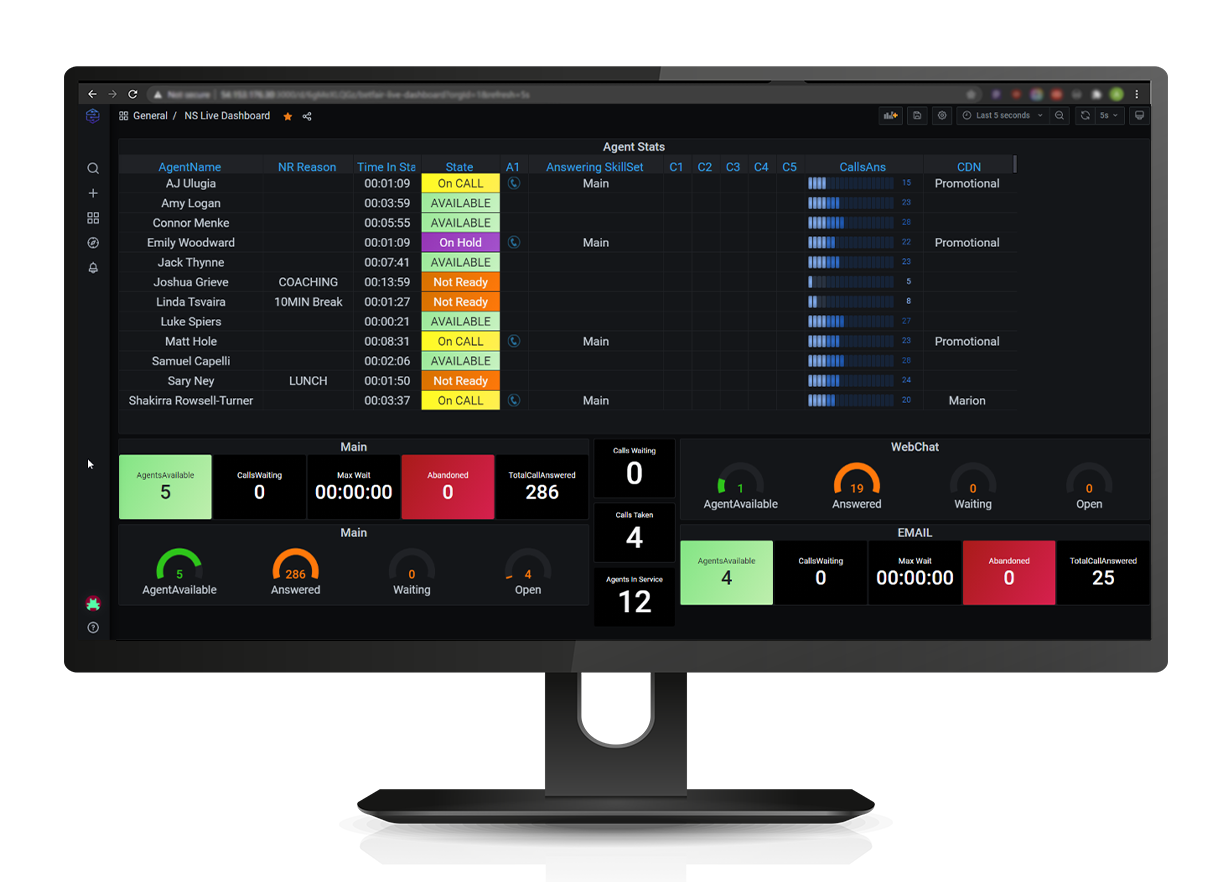
Four cost lines sit under every AI agent — Connect telephony, speech, the model and the licence. A worked example on 1,000 calls a month, and the four places the cost curve bends.