
Connect Phone vs Mobile Connect: the two Amazon Connect mobile apps
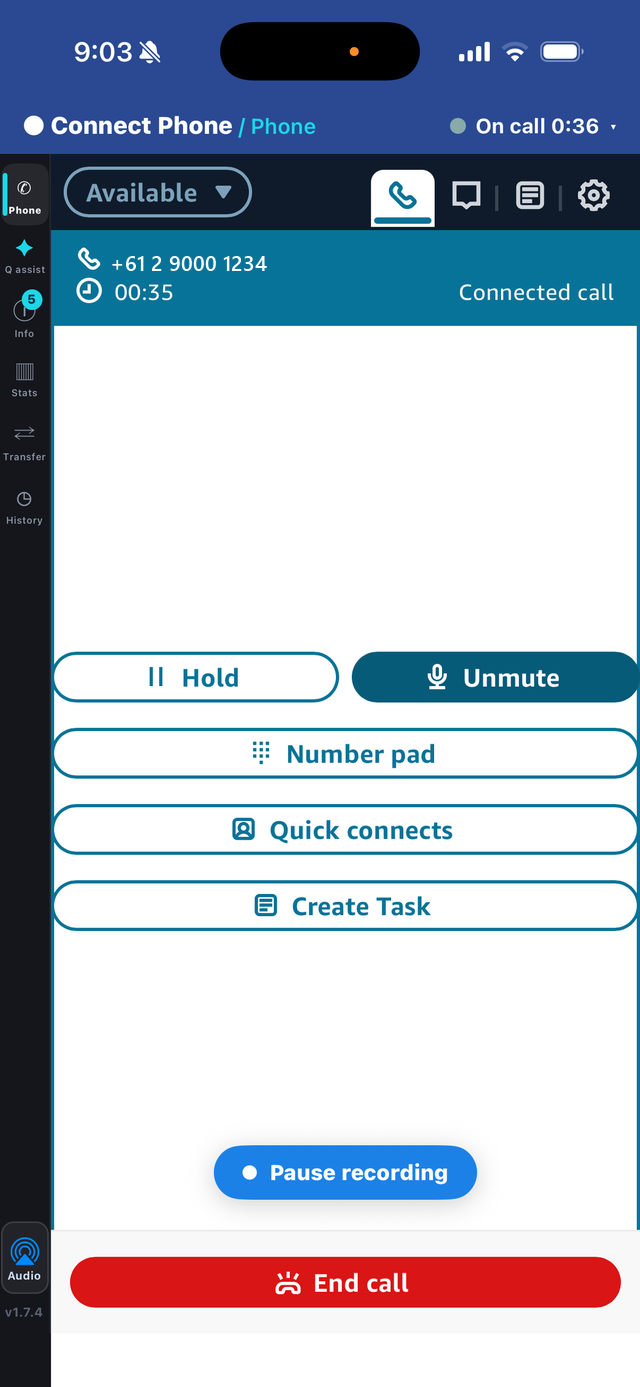
Amazon does not ship a mobile agent app for Amazon Connect. That is the starting point for this comparison, and it is worth stating plainly because a lot of search results imply otherwise: there is no AWS-owned iPhone or Android app that lets an agent take a queued call. What exists instead is a small number of third-party apps, and in practice buyers end up choosing between two of them.
We make one of them. ProUCX builds Connect Phone, so read this knowing where it comes from — but the figures below are taken from public listings rather than from marketing copy, and where the other product is the better choice, that is what it says. Competitor pricing and platform detail were checked against the AWS Marketplace listing and the App Store on 16 October 2026; both vendors change their terms from time to time, so confirm the current numbers on the listings before you commit.
The short answer
If your agents carry Android handsets or tablets, choose Mobile Connect. Connect Phone is iPhone-only today, and no amount of price advantage fixes a platform you cannot install on.
If your agents are on iPhones, and particularly if you have fewer than ten of them, Connect Phone will cost you substantially less and does not impose a minimum purchase. For a ten-person team the difference at list price is roughly US$100 a month against US$299.90.
If you are equipping a field workforce rather than a contact centre — technicians, field sales, people who are not really agents — Ideal Systems has built Mobile Connect around exactly that use case and markets it that way.
What each one costs
Mobile Connect is sold through AWS Marketplace only. The listing prices it at US$299.90 per month for a ten-user pack, which works out at about US$29.99 per concurrent user, and it is purchasable in volumes of ten — ten, twenty, thirty and so on. There is a ten-user minimum. Standard email support is included and extended support with response-time commitments is a paid add-on. A ten-day trial is available through the Marketplace.
Connect Phone is free to download from the App Store and charged per agent: US$10 per agent per month for the tier most teams use, which covers live agent statistics, smart transfer, caller history and wrap-up disposition, or US$15 per agent per month for the tier that adds queue statistics and disposition write-back. It is built for teams of five or more. You can subscribe through AWS Marketplace so it bills against your existing AWS account, or directly through the ProUCX portal.
Worked through for a team of ten, that is US$299.90 a month against US$100 a month at the ten-dollar tier. For a team of four, Mobile Connect still charges for ten users while Connect Phone charges for four.
Neither figure includes Amazon Connect itself. Whichever app you use, AWS bills your instance separately on its usual pay-as-you-go basis — voice minutes plus carrier charges — and that cost is identical either way, because both products run against your own instance rather than reselling you telephony.
Concurrent licences and named agents are not the same thing
This is the part most comparisons skip, and it can reverse the price conclusion above, so it is worth understanding before you decide.
Mobile Connect is licensed concurrently: you pay for the highest number of people logged in at the same moment, not for the number of people who have accounts. If you run a round-the-clock roster where forty staff share the app but only eight are ever on shift together, concurrent licensing is genuinely the cheaper model, and a ten-user pack covers all forty of them.
Connect Phone is licensed per named agent: you pay for each person who uses it. That is simpler to forecast and cheaper for a team where most people are working at once, which describes most business-hours contact centres.
So the honest rule is: count your peak simultaneous users, not your headcount. If peak concurrency is far below headcount, do the arithmetic again before assuming the per-agent price wins.
Platforms, where Mobile Connect is ahead
Mobile Connect runs on iOS and Android, on phones and tablets. At the time of writing its iOS build is version 12.3.8, released in September 2026, and it requires iOS 15.1 or later.
Connect Phone is iPhone only. An Android build is in development, but shipping software beats a roadmap, and if you have Android handsets in the field today this comparison is already settled. We would rather say that here than have you discover it during a trial.
What both products do the same way
Both run a real agent session against the Amazon Connect instance in your own AWS account. Neither is a call-forwarding arrangement that rings the agent's mobile number and hopes the reporting catches up afterwards, which is how most improvised “mobile” setups work and why they break contact-centre metrics.
In both cases the call is a contact in your instance from beginning to end. Your routing profiles, queues, call recording, Contact Lens and existing reporting behave as they already do, because nothing is bridging or re-originating the call. Agents take queued inbound calls, dial out, hold, mute and transfer.
What to check before you buy either one
Ask whether it rings when the app is closed, and ask for a demonstration on a real handset. This is the single most important question for mobile contact-centre software and the one most likely to be answered loosely. For Connect Phone the answer is that it rings while the app is open: iOS does not permit a browser-based softphone session to ring from a fully closed app, so agents keep it open while they are on shift. We have not tested how Mobile Connect behaves when closed and so make no claim about it — ask them, and ask to see it rather than be told it.
Check where the data sits. Call audio and recordings stay in your own AWS account with both products. What differs is where the vendor's own service runs. Connect Phone offers data residency in Australia, Singapore, the USA and Europe; if onshore processing matters to your procurement team, make it an explicit question to any vendor.
Check the minimum and the licence model. A ten-user minimum is not a problem if you have forty agents. It is most of your budget if you have four.
Check how you can pay. Mobile Connect is billed through AWS Marketplace only. Connect Phone can be billed through the Marketplace, which suits teams drawing down an AWS commitment, or invoiced directly, which suits teams whose AWS account belongs to a different part of the business.
Track record
Ideal Systems has been selling Mobile Connect for longer than we have been selling Connect Phone, and publishes named customer case studies on its site along with a stated community of more than a hundred companies. That is a real advantage and we are not going to pretend otherwise; if a long reference list is what your procurement process needs, they have one and we are earlier in that journey on mobile.
Where ProUCX has more ground behind it is the rest of the Amazon Connect estate. The same team builds the CRM connectors that put Amazon Connect inside HubSpot, Pipedrive and Dynamics 365, all listed on AWS Marketplace, so the mobile app is one piece of a connector range rather than a standalone product.
So which one
Android anywhere in the fleet, or tablets: Mobile Connect. A field workforce that is not really a contact centre: Mobile Connect. High headcount with low peak concurrency, where a ten-user concurrent pack covers forty people: run the numbers, because Mobile Connect may well come out cheaper.
An iPhone team: Connect Phone. A team under ten, where a ten-user minimum is most of the cost: Connect Phone. A requirement to bill outside AWS Marketplace, or for Australian data residency and Australian support: Connect Phone.
Both are worth trialling against your own instance rather than a demonstration environment, because the thing that decides it is usually how the app behaves on your actual roster. See what Connect Phone does, or ask us for a trial on an instance you nominate.
Common questions
Does Amazon make its own mobile app for Amazon Connect?
No. AWS does not publish a first-party mobile agent app for Amazon Connect. Agents on a phone need a third-party app, and the two most commonly compared are Connect Phone by ProUCX and Mobile Connect by Ideal Systems.
What is the cheapest way to get Amazon Connect on a mobile phone?
For a small iPhone team, Connect Phone is the lower-cost option: the app is free to download and charged at US$10 per agent per month, with no minimum purchase. Mobile Connect has a ten-user minimum priced at US$299.90 per month, so for teams of roughly thirty or more concurrent users the comparison narrows and depends on your peak concurrency.
Does either app work on Android?
Mobile Connect runs on iOS and Android, on both phones and tablets. Connect Phone is iPhone-only at present, with an Android build in development.
Do these apps ring when the app is closed?
Connect Phone rings while the app is open, because iOS does not allow a browser-based softphone session to ring from a fully closed app; agents keep it open during a shift. We have not tested Mobile Connect's behaviour when closed and make no claim about it. Ask any vendor to demonstrate closed-app ringing on a real handset before relying on it.
Do I still pay AWS for Amazon Connect as well?
Yes. Both products run against the Amazon Connect instance in your own AWS account, so AWS continues to bill your instance on its usual pay-as-you-go basis for voice minutes and carrier charges. That cost is the same whichever app you choose.
What is the difference between concurrent and per-agent licensing?
Concurrent licensing charges for the highest number of users signed in simultaneously, so a ten-user pack can cover a much larger roster where only a few people are on shift at once. Per-agent licensing charges for each named person. Mobile Connect is licensed concurrently and Connect Phone per agent, so which is cheaper depends on how far your peak concurrency sits below your headcount.
Can I trial either product before buying?
Mobile Connect offers a ten-day trial through AWS Marketplace. Connect Phone can be trialled against an Amazon Connect instance you nominate, so it can be evaluated on your own routing and queues rather than in a demonstration environment.
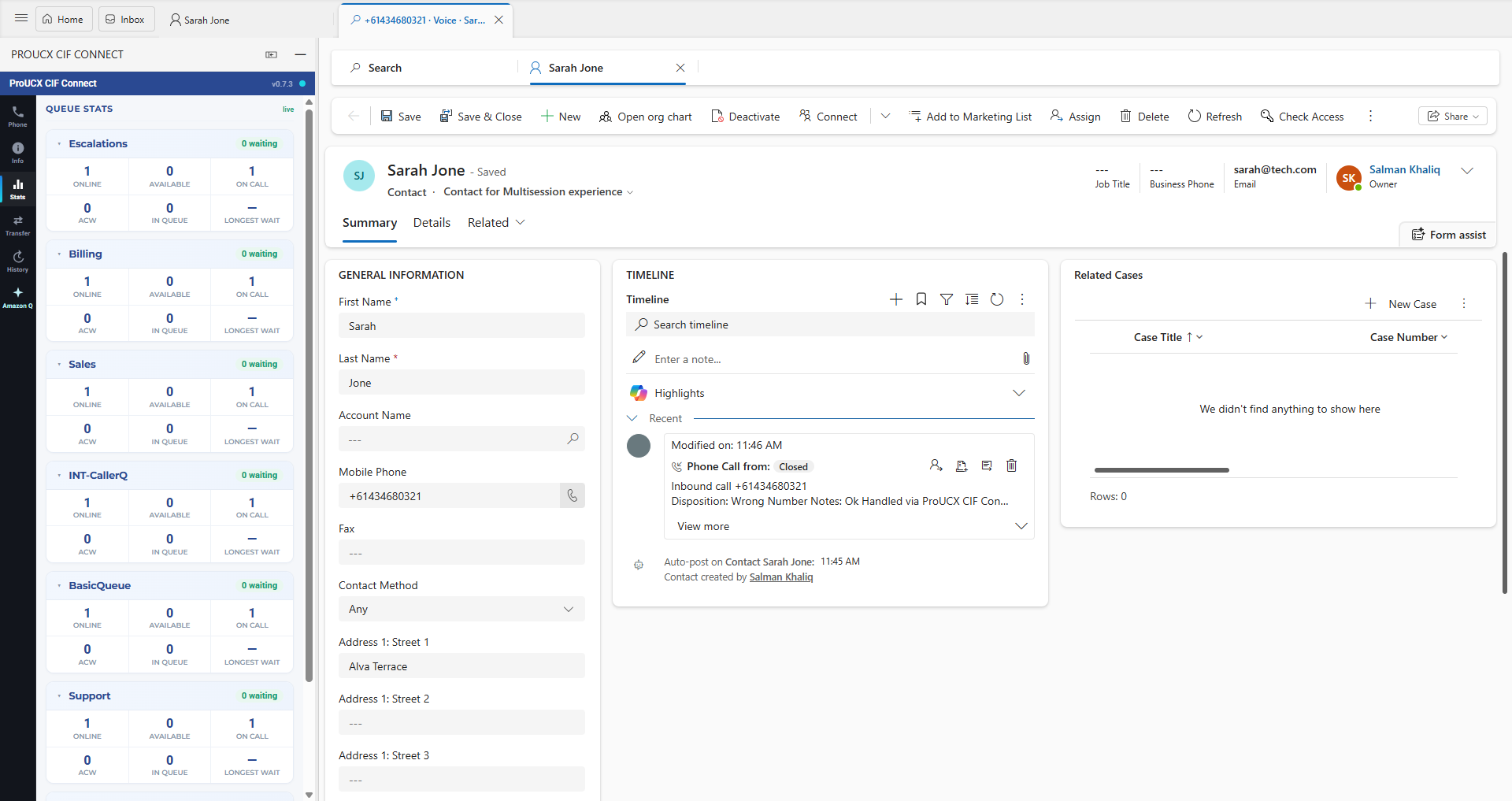
Link, embed, CTI or full workspace — four products at four prices. What screen-pop really requires, how logging differs per CRM, and the eight questions to ask before signing.
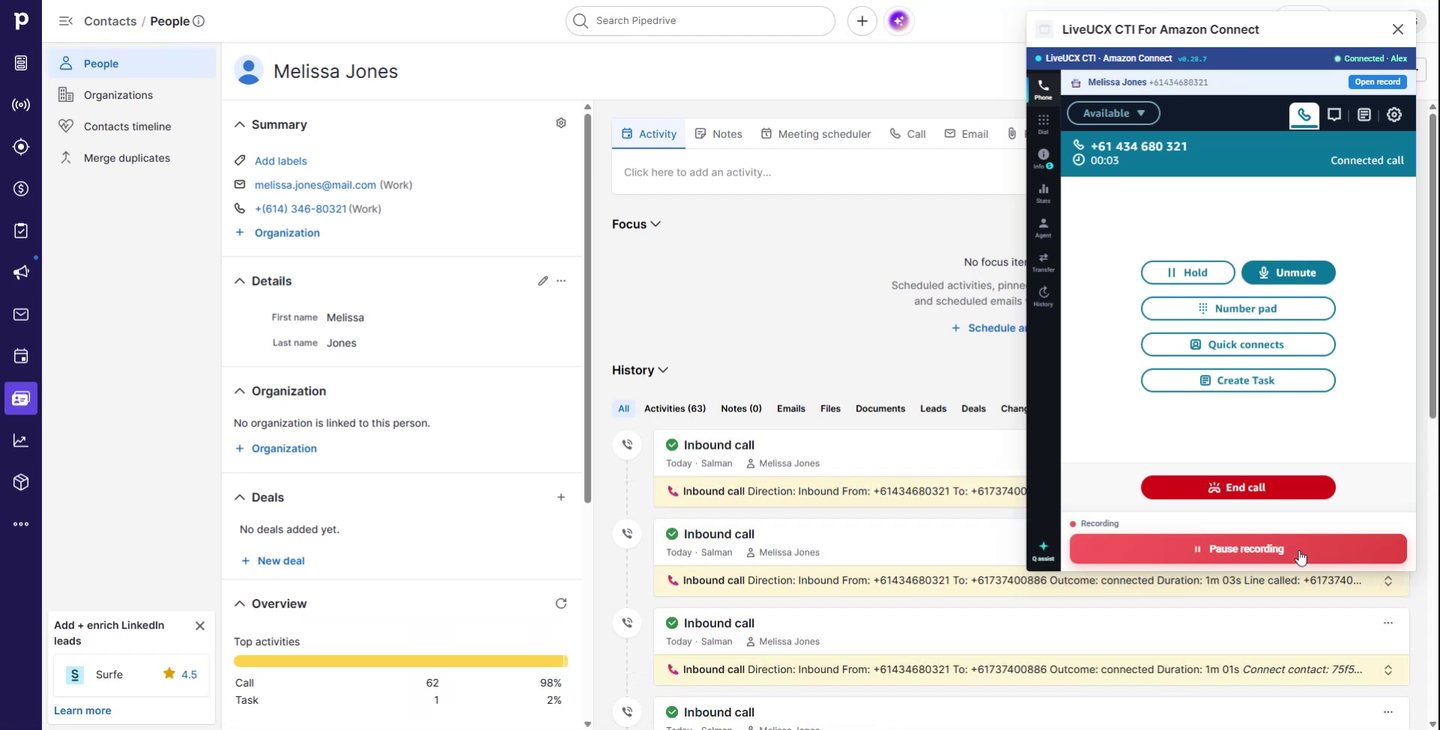
What Pipedrive does natively and where it stops, what a real CTI connector adds, why screen-pop matching is harder than it looks, and how to get the connector live.
All three cover the enterprise CRMs and all three leave the mid-market to connectors. Native coverage, the five cost lines, migration friction, and what to do if the CRM is Dynamics, HubSpot or Pipedrive.