
Amazon Connect vs NICE CXone vs Genesys — for CRM integration
All three cover the enterprise CRMs well and thin out at the same point. Platform comparisons usually argue about routing engines, AI roadmaps and licence models, but for a very large number of buyers the decision is settled by something narrower: which of these platforms will put a call inside the CRM our people actually work in, and what does that cost once the platform licence is paid? ProUCX builds connectors for all three, so this is written from the connector side of the fence rather than the platform side.
How the three approach CRM integration
All three are credible cloud contact centre platforms. They differ in how CRM integration is delivered, and that difference drives cost more than any feature comparison.
Amazon Connect is an AWS service, and it behaves like one. It publishes an agent workspace and an embeddable contact panel, plus the Streams API for building call control into another application, and AWS itself publishes integrations for the largest CRM platforms. Beyond those, the model is deliberately open: it expects you or a partner to build the integration, and it gives you the APIs, the events and an agent-workspace app framework to do it. Consumption pricing, and your data — including recordings — stays in your own AWS account and region.
NICE CXone takes the packaged approach. It ships named agent integrations for the major CRM and ITSM platforms, distributed through its CXexchange marketplace, and the integration is a product you enable rather than an SDK you consume. That's a genuine advantage when your CRM is on the list — less to build, one vendor accountable — and a genuine constraint when it isn't.
Genesys Cloud sits between the two. It publishes embedded clients for the major CRM platforms, runs the AppFoundry marketplace for partner integrations, and exposes client SDKs and an embeddable framework for building your own. Its integration story is mature and its partner ecosystem is large.
Licensing models differ substantially between the three — named versus concurrent seats, bundled versus consumption — and vendors change them, so price them from current vendor quotes rather than from any comparison article, this one included.
Where each leaves you to buy a connector
Here is the pattern that matters, and it is the same on all three platforms: native CRM coverage is excellent for the enterprise CRMs and thin everywhere else.
Salesforce, ServiceNow, Zendesk and Microsoft Dynamics 365 are well served by first-party or vendor-published integrations across the board. Past that tier — Pipedrive, HubSpot, Front, Odoo, Freshworks and the rest of the mid-market — none of the three platforms offers comprehensive first-party coverage, and this is precisely where the independent connector market exists. We looked at the shape of that gap across six contact centre marketplaces in the CRM integration market: where the connector gaps are.
The practical consequence is that "does it integrate with our CRM" has three possible answers, and you need to know which one you're getting: the platform vendor ships it; a partner ships it; or somebody builds it. Only the first is included in the platform licence.
Total integration cost, by platform
Don't compare sticker prices. Compare five lines, and compare them over three years.
- Platform licence or consumption. Seats or usage, per the vendor's current model.
- Telephony. Sometimes bundled, sometimes separate, sometimes bring-your-own-carrier. It is a bigger number than people expect and it varies more between platforms than the licence does.
- The connector. Included, purchased per agent, or built.
- Implementation. Flows, routing design, CRM field mapping, testing, training.
- Maintenance. The line nobody budgets. Both the platform and the CRM will ship breaking changes on their own schedules for as long as you run them.
Two structural differences are worth knowing. Amazon Connect's consumption model means an idle contact centre costs very little and a busy one costs proportionally more, which suits seasonal and event-driven operations; per-seat models suit stable rostered teams and make budgeting simpler. And where a connector is bought through AWS Marketplace, it appears on an AWS bill you already reconcile and may count toward an existing AWS commitment — which for larger organisations frequently saves more in procurement time than the licence costs.
Migration friction
If you're moving rather than starting fresh, five things generate the real effort, and the CRM integration is only one of them.
- Numbers. Porting is a carrier process on a carrier timeline. It is the least technical and most delay-prone part of any migration.
- Flows and scripting. Routing logic doesn't port. It gets rebuilt, and the rebuild is a good opportunity to delete the eleven branches nobody has used since 2021.
- The recording archive. Historical recordings are the reason old platforms stay licensed for years after cutover. Plan it as its own workstream — we set out how in getting your call recordings out of Verint before you switch platforms, and the approach generalises to any recording platform.
- Reporting continuity. Metric definitions differ between platforms, so your service level will appear to change on cutover day even if nothing operationally did. Agree the definitions in advance, and if you're running two platforms during transition, put them on one board — that's exactly the case for a multi-platform wallboard.
- Integration rebuild. The CTI layer is platform-specific. A connector built for one platform does not move to another, which is worth remembering when you are told an integration is "just an API".
A hybrid estate is also a legitimate end state rather than a failure. Plenty of organisations run one platform for the contact centre and another for a division they acquired, and never consolidate because the business case never clears. Build the integration and reporting strategy for that reality.
You do not have to cut over all at once
The five items above assume a single cutover date, which is how most migrations get scoped and part of why they stall. Amazon Connect documents a staged alternative, and it changes where the CRM integration sits in the plan.
AWS describes Amazon Chime SDK Voice Connector as an interim step on the migration path: connect your existing PBX or SBC to AWS first and run PSTN connectivity through it, then move to Amazon Connect when you are ready. Numbers already on the Voice Connector port across to Amazon Connect directly, without going back through an external carrier — which takes the most delay-prone item on the list off the critical path for those numbers. AWS states that Amazon Connect supports phased cutovers from legacy PBX systems, with call handling moved incrementally while the existing platform keeps running.
There are two documented ways to run Amazon Connect alongside a voice platform you have not retired yet. One transfers calls and their metadata between Amazon Connect and another voice system directly, without the public telephone network, so you can put Amazon Connect telephony and IVR in front of an existing contact centre and migrate agents later. The other points Contact Lens at your existing voice system through a SIPREC feed, so you get recordings, transcripts and analytics before any agent moves.
Both carry conditions worth knowing before you build a plan around them. The call transfer connector is a gated feature — AWS asks you to go through your account team rather than switching it on yourself, so treat it as a conversation with a lead time, not a configuration step. The analytics route needs SIPREC on the system sending the audio, a supported session border controller, and a region your voice system can reach; streamed calls are also capped at three hours forty-five minutes, which matters if you run long supported sessions.
The consequence for the subject of this page is specific. If you take the IVR-first route, the CRM integration lands with the agent migration rather than at the start, because there are no Amazon Connect agents to screen-pop into until that phase. If you take the analytics-first route, nothing about the CRM changes at all in phase one. Either way, sequence the connector work against the agent phase and not against the first switch-on date — a mistake we have watched turn into a connector built, paid for and left idle for a quarter.
One caveat, stated plainly because it cuts against us: we have verified this path in AWS’s own documentation and not the equivalent for NICE CXone or Genesys Cloud, both of which run large migration practices and may well offer something comparable. Ask each vendor what a phased cutover looks like on their platform and what it is gated behind. Do not read the asymmetry of this section as a finding about the other two.
NICE also sells into Amazon Connect, which makes this less of a straight choice
Almost everyone arriving at this comparison is treating it as either/or: pick NICE CXone as the platform, or pick Amazon Connect. NICE’s own comparison page is written that way too. It is worth knowing that NICE does not only compete with Amazon Connect — it also sells a catalogue of products that run on top of it, and that changes what the decision actually is.
On its own partner page NICE offers four things for Amazon Connect: Workforce Management, NiCE Engage recording, CXone Workforce Optimization (WEM) and Real-Time Authentication. NICE states there that its “Customer Engagement solutions integrate seamlessly with the Amazon Connect cloud-based contact center”, and describes itself as an APN — AWS Partner Network — Technology Partner. So “we have chosen NICE” and “we are not using Amazon Connect” are not the same statement, and in a surprising number of rollouts only the first one is true.
The consequence for the subject of this page is specific. If you run Amazon Connect as the telephony platform with NICE products layered on for workforce management, recording or authentication, you still have an Amazon Connect contact centre as far as CRM integration is concerned. Screen-pop, click-to-dial and call logging come from a contact-centre-to-CRM connector on the Amazon Connect side; the NICE layer is not what puts a softphone on a Dynamics 365, HubSpot or Pipedrive record. Work out which of the two shapes you are actually buying before anyone prices a connector, because the answer decides which column of the cost table above applies to you.
Two limits on what we have just said, because they cut against the convenient reading. This is not evidence that one platform is cheaper or better than the other, and buying CXone as your contact centre is a genuinely different purchase from buying NICE WEM to sit on Amazon Connect — different licences, different support model, different migration. We have also not verified pricing, regional availability, or whether these remain current SKUs, so confirm the catalogue with NICE rather than with us. And as with the phased-cutover section above, we have not verified an equivalent Genesys-on-Amazon-Connect catalogue; read this as a fact about NICE, not as a finding about Genesys.
Which to choose if the CRM is Dynamics, HubSpot or Pipedrive
Being specific, and being fair to all three platforms:
Dynamics 365. All three platforms have a credible route, because Microsoft's Channel Integration Framework v2 is a documented integration surface any vendor can build to. Choose on contact centre requirements, not on the CRM. If you land on Amazon Connect, ProUCX's Amazon Connect Dynamics 365 CTI connector is a CIF v2 provider — and if you are weighing Microsoft’s own contact centre instead, that is compared here; if you land on CXone, we build the same integration for NICE CXone.
HubSpot. HubSpot's Calling Extensions SDK is the supported embedding route and it is open to any provider, but first-party contact centre coverage is thin across all three platforms. Amazon Connect plus a connector is currently the most direct path — ProUCX's Amazon Connect HubSpot integration. Whether you need it at all is a separate question, answered in Amazon Connect + HubSpot versus HubSpot's native calling.
Pipedrive. The thinnest native coverage of the three CRMs on every platform, and correspondingly the clearest connector decision. ProUCX ships connectors for Amazon Connect, NICE CXone and RingCentral, so the CRM shouldn't constrain the platform choice.
The honest summary: for these three CRMs, the CRM should rarely be the deciding factor, because a connector exists or can be built for each platform. Decide on routing sophistication, commercial model, data residency, AI strategy and what your people already know how to operate — then make sure the connector is contracted, not assumed.
Where the three genuinely differ
Setting connectors aside for a moment, since this comparison would be dishonest without it:
Amazon Connect suits organisations already committed to AWS, with engineering capability, variable volumes, and a preference for owning their data and composing services. It asks more of you and gives more control in return.
NICE CXone suits organisations wanting a complete packaged suite with workforce management and quality management in the box, and a single vendor to hold accountable.
Genesys Cloud suits organisations wanting deep out-of-the-box contact centre functionality with a large partner ecosystem and a mature marketplace.
All three will handle a mainstream contact centre workload competently. The failure modes are organisational, not technical: choosing the composable platform without the engineering capacity to compose, or choosing the packaged suite and then needing to change something the package does not expose.
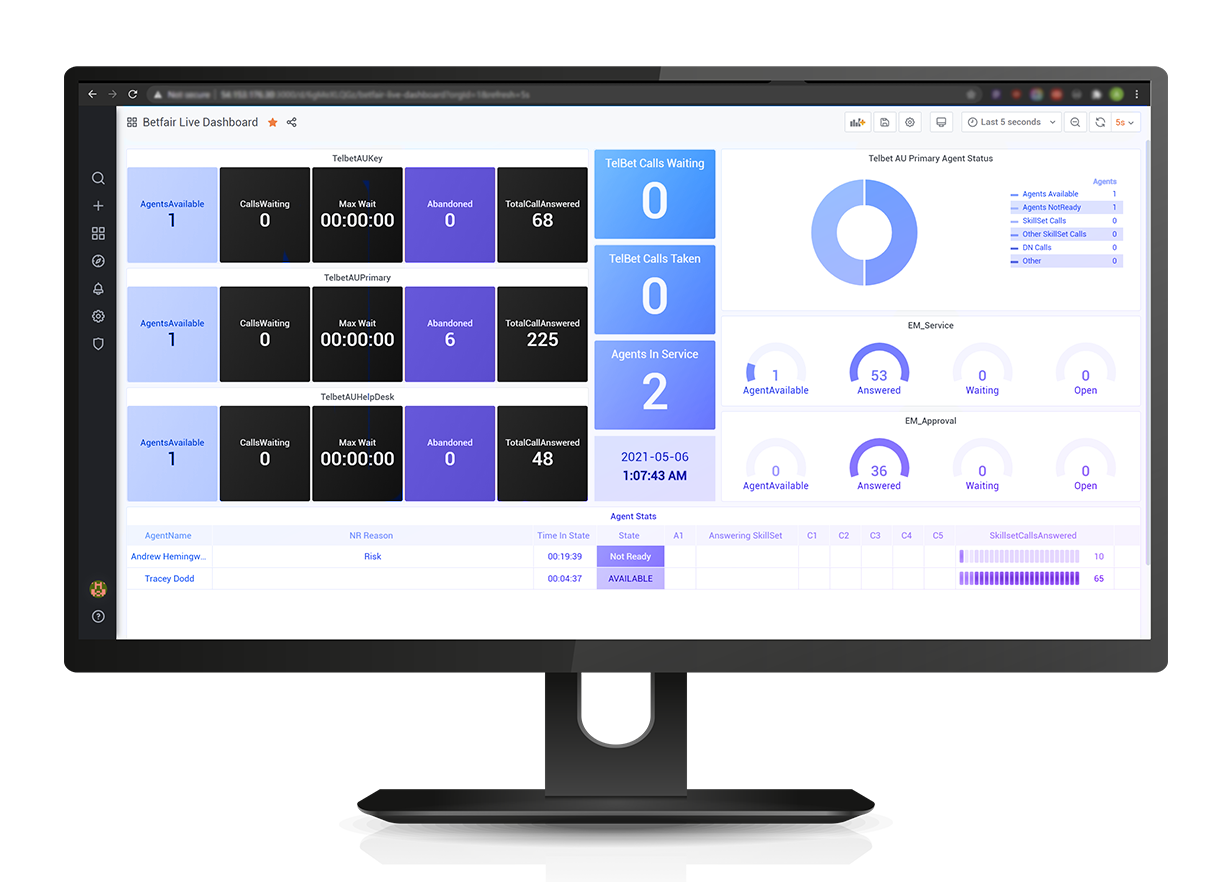
Whichever you choose, real-time visibility across the estate is a separate purchase in practice, because each platform reports on itself and nothing else. That's the case for platform-independent reporting, and it's why LiveUCX reads Amazon Connect, CXone, Genesys, Avaya, RingCentral and Zoom onto the same board.
The short version
For enterprise CRMs all three platforms have you covered natively. For the mid-market — Pipedrive, HubSpot, Front and the rest — every one of them leaves you buying or building a connector, so budget for it explicitly rather than assuming the platform licence includes it. Compare on the five cost lines over three years, plan the recording archive and the reporting continuity as their own workstreams, and choose the platform on operating model rather than on a feature matrix.
NICE CXone and Genesys Cloud, compared on the CRM question
Most of this page is written Connect-first, because that is where the architectural difference is sharpest. But a large share of buyers are not considering Amazon Connect at all — they are down to NICE CXone and Genesys Cloud and want to know whether the CRM question separates them. On the narrow axis this page covers, here is the honest answer.
They are more alike than different. Both are packaged platforms rather than toolkits. Both publish first-party integrations for the enterprise CRM tier. Both run a partner marketplace — CXexchange for NICE, AppFoundry for Genesys — where integrations that are not first-party are distributed. If your CRM is Salesforce, ServiceNow, Zendesk or Dynamics 365, both will have an answer, and the CRM question will not be what decides your shortlist.
The difference shows when your CRM is not on the list. Genesys Cloud exposes client SDKs and an embeddable client framework, so building your own integration, or having a partner build it, is a supported path with documented primitives. NICE CXone's integrations are closer to products you enable than SDKs you consume. Both positions are defensible — the packaged one means less to build and one vendor accountable; the open one means you are not blocked when your CRM is outside the supported set — but they lead to different projects, and different costs, for a mid-market CRM.
What this page cannot tell you is which platform is better overall. Routing sophistication, workforce management, analytics depth, AI roadmap and the commercial terms you are actually offered will matter more to most organisations than the CRM connector, and none of those are assessed here. Treat this as one input to a shortlist rather than a verdict on it.
If you are earlier than that and still drawing up the shortlist, we have set out what the Genesys alternatives lists leave out — the integration questions to ask every vendor on it.
Common questions
Can you run Amazon Connect alongside your existing contact centre?
Yes, and AWS documents two ways. One transfers calls and their metadata between Amazon Connect and another voice system without using the public telephone network, which lets you front an existing contact centre with Amazon Connect telephony and IVR and migrate agents later; it is a gated feature, so it goes through your AWS account team. The other points Contact Lens at your existing platform over a SIPREC feed for recordings and analytics before any agent moves. Both are Amazon Connect-specific as far as we have verified — ask NICE and Genesys what their equivalent is.
When should the CRM integration be built in a phased migration?
With the agent phase, not the first switch-on. If phase one is Amazon Connect telephony and IVR in front of your existing contact centre, there are no Amazon Connect agents to screen-pop into yet, and if phase one is analytics only then nothing about the CRM changes. Building the CTI layer against the earliest date on the plan is how a connector ends up bought and idle for a quarter.
Is Amazon Connect better than NICE CXone?
Neither is better in the abstract, and the honest answer depends on what you are optimising for. Amazon Connect is an AWS service you assemble: open APIs, consumption pricing, your data in your own account, and an expectation that you or a partner will build what is not in the box. NICE CXone is a packaged suite where workforce management, quality and analytics arrive as part of the product. If you have engineering capacity and want control, the first model suits you. If you want less to build and one vendor accountable, the second does.
How do NICE CXone and Genesys Cloud differ on CRM integration?
Less than most comparisons suggest. Both publish first-party integrations for the enterprise CRM tier and both run a partner marketplace — CXexchange for NICE, AppFoundry for Genesys. The difference appears when your CRM is outside the supported set: Genesys Cloud exposes client SDKs and an embeddable client framework, so building your own is a documented path, whereas NICE's integrations are closer to products you enable than SDKs you consume.
Which CCaaS platform offers the most CRM integrations?
Counting marketplace listings is a poor guide, because the counts include partner apps of very different quality and depth. A more useful question is which of the three answers you are getting for your CRM: the platform vendor ships it, a partner ships it, or somebody builds it. All three platforms cover the enterprise CRM tier well and thin out at the same point, roughly below Salesforce, ServiceNow, Zendesk and Dynamics 365.
Which is cheaper, Amazon Connect or Genesys Cloud?
The models are too different for a list-price comparison to mean much. Amazon Connect is consumption-based, so cost tracks interaction volume; Genesys Cloud is seat-based with bundled capability. A seasonal operation and a steady one will reach opposite conclusions from the same rate card. Licensing also changes, so price both from current vendor quotes rather than from any comparison article, including this one — and include the integration work in the total, because that is where the published numbers usually stop.
Do all three platforms support CRM screen-pop?
Yes, where an integration exists for your CRM. Screen-pop is a baseline capability rather than a differentiator, and the real question is not whether the platform can do it but whether an integration exists for the CRM you run — and if not, who is going to build it.
What does a native CRM integration actually include?
It varies more than the word suggests. At minimum it usually means an embedded softphone and screen-pop on inbound calls. It may or may not include click-to-dial, automatic activity logging, recording links, wrap-up disposition written back to the CRM, or multi-channel beyond voice. Ask for the specific list rather than the label, because two products described as native integrations can differ substantially.
Which platform is easiest to migrate an on-premises contact centre to?
Migration friction depends far more on what you are leaving than on what you are joining: how much custom routing logic exists, how many integrations are in the current estate, and whether historical recordings have to come with you. Recording migration in particular is routinely underestimated and is often a separate project in its own right, whichever platform you choose.
Does this comparison cover routing, workforce management or AI?
No. This page compares the three platforms on CRM integration only, because that is the part we work on directly and can speak about from building connectors for all three. Routing sophistication, workforce management, analytics and AI roadmap will matter more to most organisations, and they are not assessed here.
Is NICE a competitor to Amazon Connect, or a partner?
Both, which is why the comparison confuses people. NICE CXone competes with Amazon Connect as a contact-centre platform, and NICE separately sells Workforce Management, NiCE Engage recording, CXone Workforce Optimization and Real-Time Authentication to run on Amazon Connect, describing itself on its partner page as an AWS Partner Network Technology Partner. Which relationship you are in depends on which of those you are buying.
If we run NICE workforce management on Amazon Connect, which CRM connector do we need?
An Amazon Connect one. The CRM integration follows the telephony platform, not the workforce-management layer, so screen-pop, click-to-dial and call logging come from a connector built against Amazon Connect. Adding NICE products on top does not change what the CRM side needs.
Does choosing NICE mean we are not using Amazon Connect?
Not necessarily, and it is worth settling early because it decides the whole integration budget. A NICE platform deployment and an Amazon Connect deployment with NICE products layered on it are two different architectures that both get described internally as “we went with NICE”. Ask which system owns the telephony, because that is the one your CRM connector has to talk to.
Connectors for the platform you choose
Amazon Connect, NICE CXone and RingCentral connectors, an AI voice agent and real-time dashboards — all on AWS Marketplace.
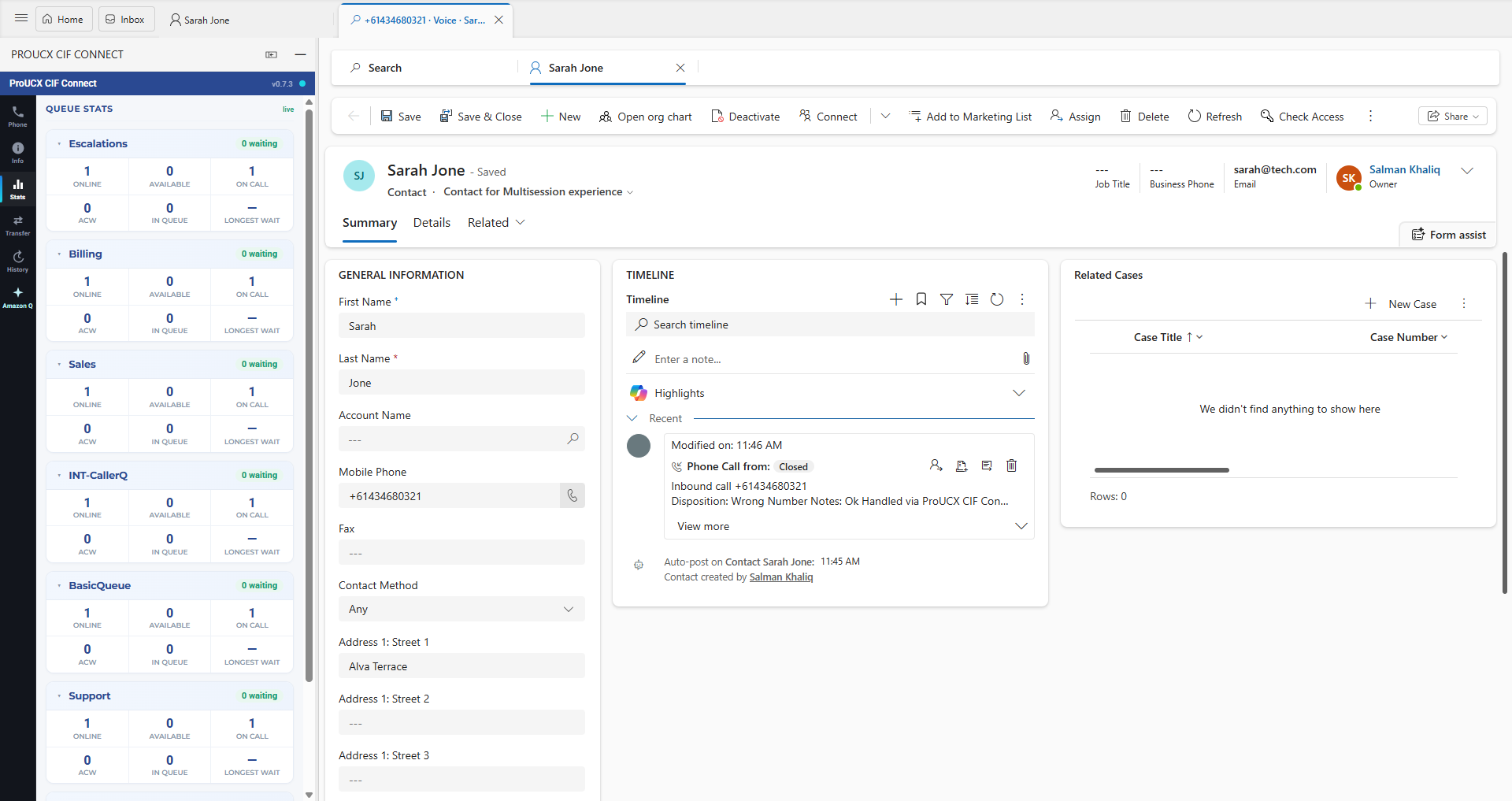
Link, embed, CTI or full workspace — four products at four prices. What screen-pop really requires, how logging differs per CRM, and the eight questions to ask before signing.
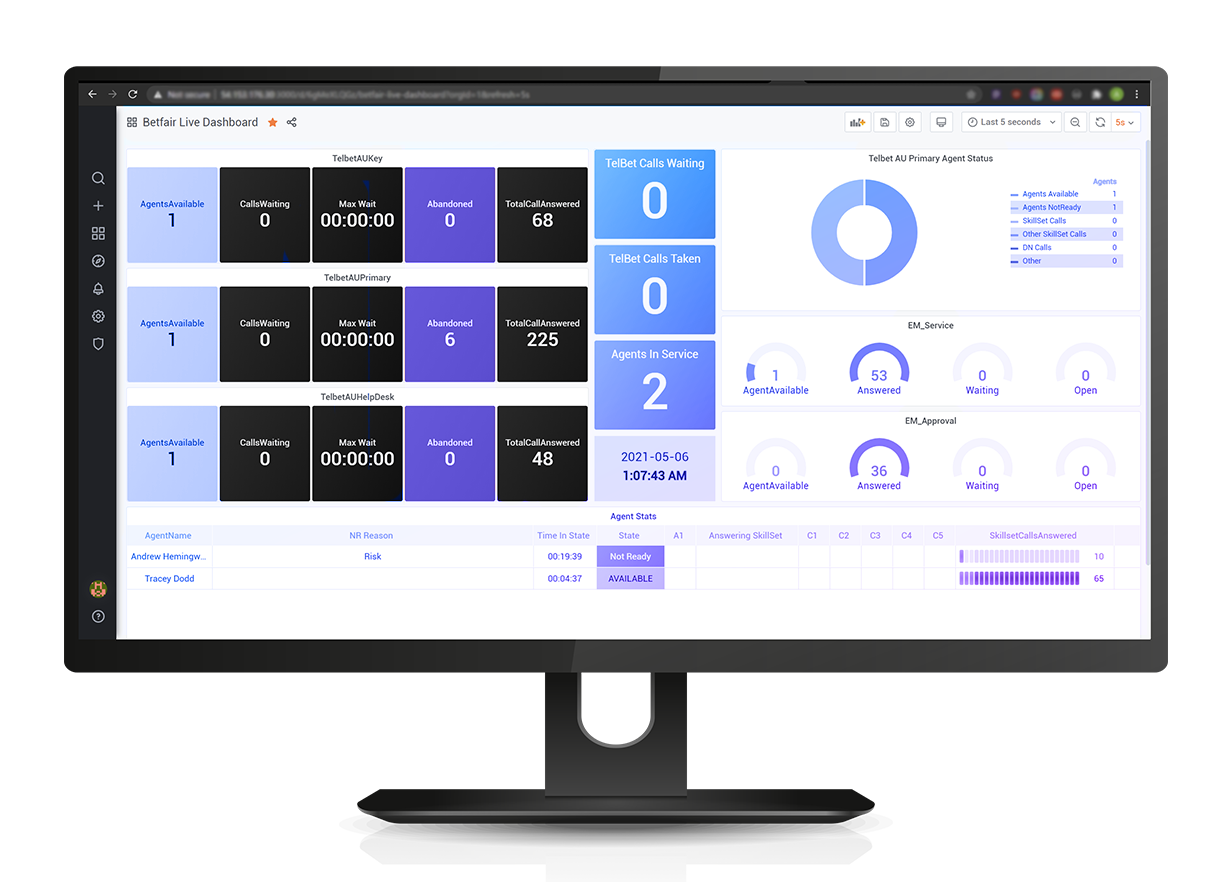
Native CTI coverage collapses past Salesforce and Zendesk — and a 2028 Salesforce deadline is about to reset the board. Our analysis of six contact-centre marketplaces.
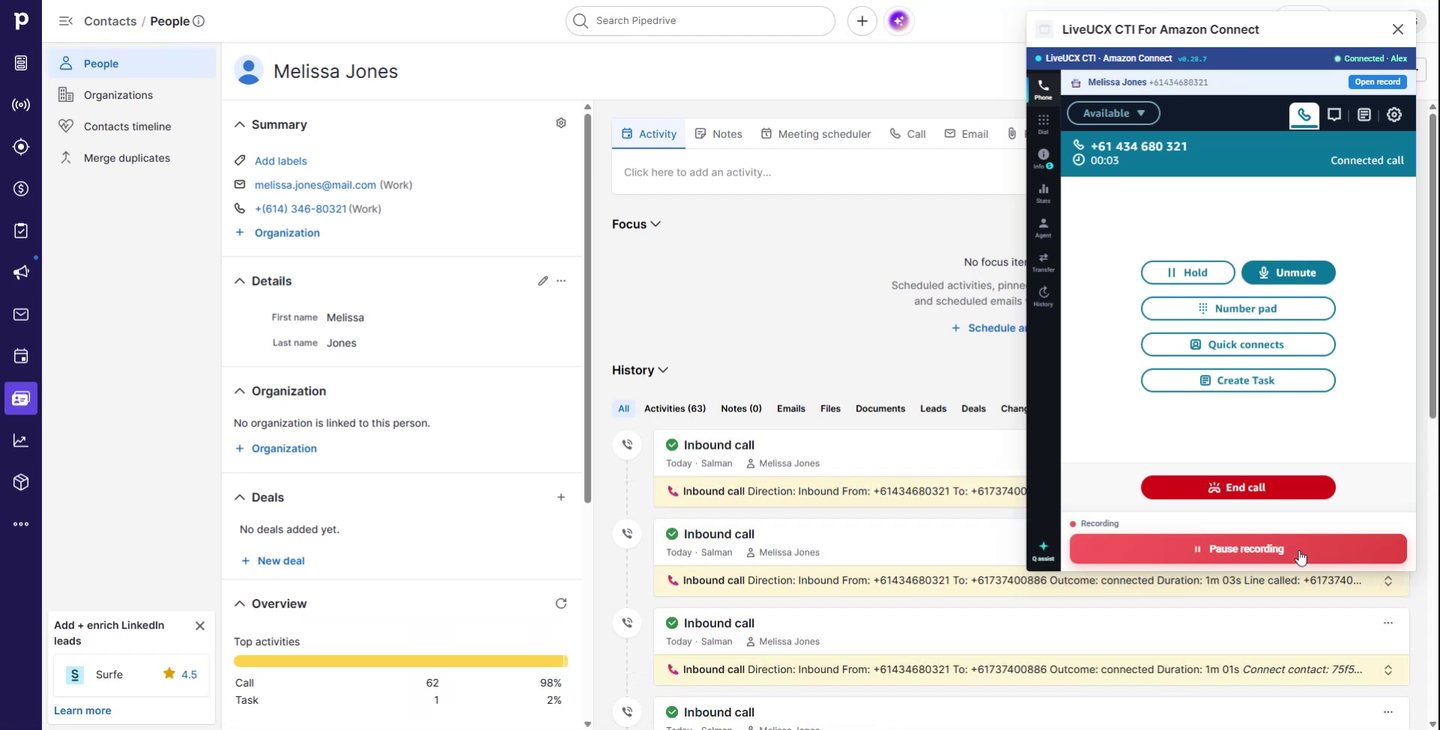
What Pipedrive’s built-in calling covers, where a CRM stops being a contact centre, and what changes when an Amazon Connect CTI takes over the call.